W123 Flasher
ESP8266 firmware that adds comfort turn signals and four hazard light patterns, configured over Wi-Fi, to a Mercedes W123.
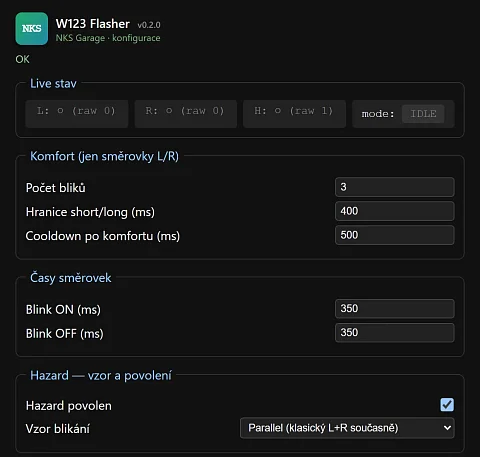
W123 Flasher is ESP8266 firmware that adds comfort turn signals to a Mercedes W123. When the driver of a newer car changes lanes, a tap on the stalk is enough and the indicator flashes three times on its own. The Mercedes W123, built from 1976 to 1986, cannot do this: it flashes while the stalk is held and stops when it is released. Anyone who drives the old car every day notices the difference at every overtake. The small ESP8266 board is wired between the indicator stalk, the hazard switch and the relay. It adds comfort flashing and more hazard light patterns, and everything is set from a phone over Wi-Fi.
Settings without a soldering iron or reflashing
If the flash timings were hard-coded in the program, every change would mean taking the board out of the car, editing the program and flashing it again. Yet the speed and number of flashes are exactly what every owner wants to tune. W123 Flasher keeps all timings and patterns in settings that are changed in a web interface and saved to the board's memory. A change applies immediately and survives a power cut.
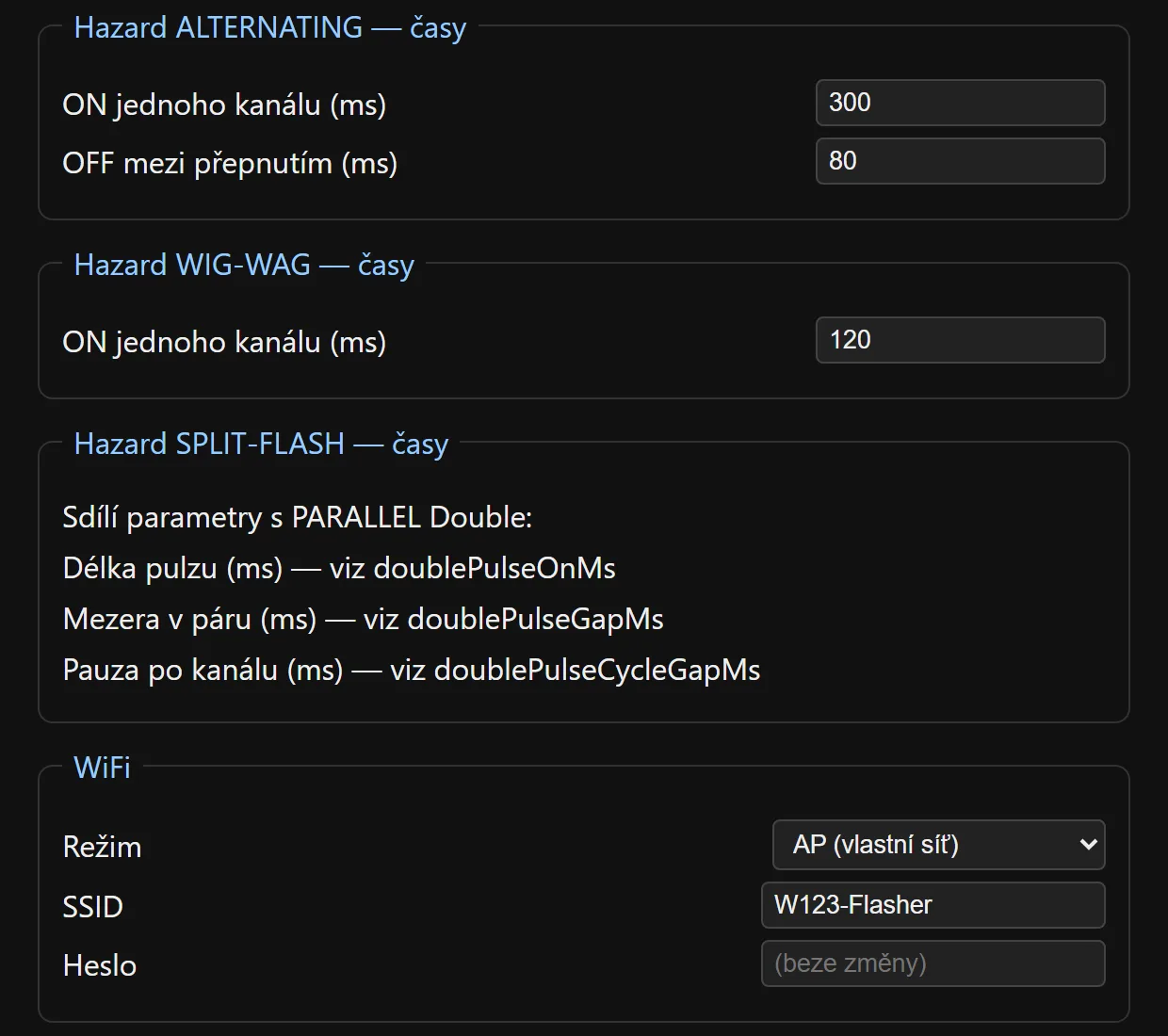
Indicators: tap or hold
- A short press of the stalk (shorter than 400 ms by default) starts comfort flashing. The indicator flashes a set number of times, three by default.
- A long press works as before: it flashes while the stalk is held and, on release, finishes the cycle in progress, so the last flash is not cut off halfway.
- Switching sides during flashing finishes the running cycle and moves smoothly to the other side. Both sides never light up at once.
- A guard pause after comfort flashing (500 ms by default) ignores another press, so a bouncing contact in the old stalk does not start flashing again.
Four hazard light patterns
| Pattern | How it flashes |
|---|---|
| Simultaneous | both sides at once, with a single flash or a double flash |
| Alternating | left, pause, right, pause |
| Wig-wag | left and right alternate with no pause |
| Split-flash | double flash left, pause, double flash right, pause |
Each pattern has its own timings in milliseconds. A short tap on the hazard switch always completes at least one full cycle. The default pattern is simultaneous, because hazard lights are expected to flash all indicators at the same time; UN ECE Regulation No. 48 describes it that way too. The alternating patterns are meant for car meets, shows or private property.
A web interface on your phone
The board creates its own Wi-Fi network or joins an existing one, for example in the garage. Once connected, a settings page opens in the browser. At the top is the live state: which inputs are active and which mode is running, refreshed four times a second. During wiring you can see right away whether the board reads the stalk and switch correctly, with no multimeter or laptop at the car.
New firmware versions are uploaded from the same page. The board receives the update over Wi-Fi, writes it to the second part of its memory and restarts. A new version can also be uploaded from the command line, again without a cable. The firmware version is shown in the page header. The "Reset na defaulty" (reset to defaults) button restores factory settings. A simple REST API does the same as the page: it returns the current settings and the live input state, accepts settings changes and, on request, restarts the board or restores factory settings. The board can therefore be controlled from your own script as well.
Safe behaviour at power-up
For the first second after power is connected, the board does not read its inputs and keeps the relays off, so nothing flashes before the inputs settle. The hazard input reacts only after it has first seen the idle state; a disconnected or loose wire therefore does not start flashing. The indicator stalk, on the other hand, may already be active at power-up, because the driver may well be holding it. Each input goes through 20 ms debouncing, so short contact bounces do not count as a press.
Hardware
The firmware runs on a NodeMCU LOLIN V3 board with the ESP8266 chip. The relay is switched by a common opto-isolated module of the kind sold for Arduino and ESP boards. Input polarity can be adjusted when building the firmware, depending on whether the switch connects to positive or to ground. At power-up the relay may click for a fraction of a second; one extra resistor on the output prevents it.
Who it is for
- Mercedes W123 owners who drive the car every day and want comfort flashing as in newer cars.
- Workshops and restorers who want an add-on configured by phone instead of a fixed module.
- Owners who take their cars to meets and shows and want more hazard light patterns.
Project status
W123 Flasher is in development; the current version is 0.2.0. Comfort flashing, all four patterns, the web interface and Wi-Fi updates work. The firmware has no low-power sleep mode yet; the board runs as long as it has power.
Interested in using it?
Want W123 Flasher in your car? Write through the enquiry form or to dev@nks-hub.cz.