LiberNT Update
LiberNT Update is a signed updater for the LiberNT operating system: a Python build publisher and a Win32 C++17 client that replaces only changed files, at restart or live, and can roll an update back.
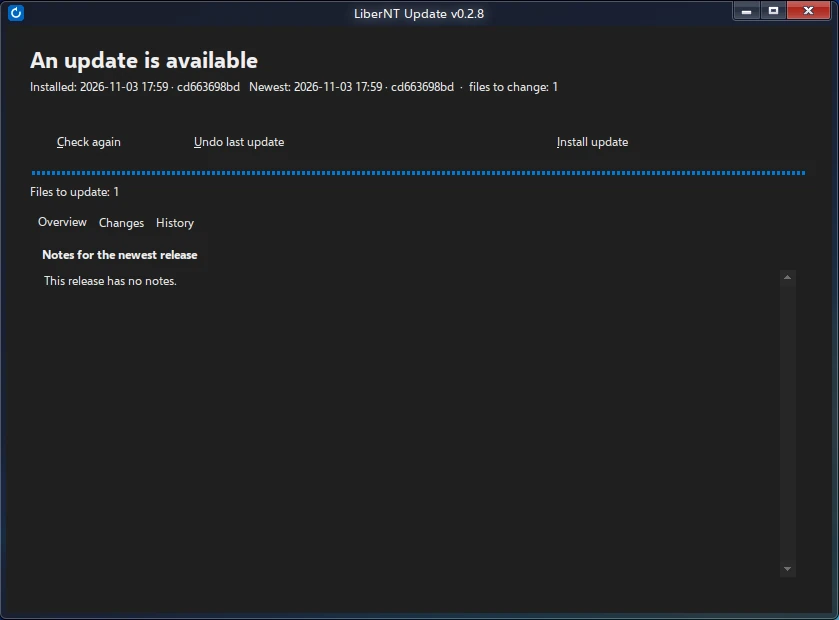
LiberNT Update is a signed updater for LiberNT, a free operating system compatible with Windows NT. Without it, moving to a newer build means reinstalling from a disk image. LiberNT Update compares the installed system with the new build file by file, downloads only the files that differ and keeps a backup before replacing anything, so the update can be undone.
What is ours and what belongs to the LiberNT project
The LiberNT operating system is not ours. It is developed by the independent LiberNT project under the GPL 3.0 licence, and its repository is based on ReactOS. According to its own README it aims at Windows 11 compatibility on amd64, arm64 and riscv64; its releases are still debug pre-releases for testing in a virtual machine.
Two things are ours. The first is the libernt-update repository: a build publisher in Python and a Win32 client in C++17, all under the MIT licence. The second is the public fork nks-hub/LiberNT. Its nks branch carries our patches to the system, and GitHub Actions merges the upstream main-nt10 branch into it every day at 03:17 UTC. A merge conflict opens an issue and waits for a manual fix. The patches in the fork are under GPL 3.0 like the rest of the system.
As of 6 November 2026 the fork has 11 patches, each on its own nks-feat/… or nks-fix/… branch so that it can be offered upstream separately. The updater needs three of them: SMSS runs native commands in an UpdateExecute phase only after the registry is initialised, a registry write flushes every hive block that a changed cell spans, and drivers that start at boot get their own service key. The rest are compatibility fixes: sas.dll with SendSAS, printer driver package functions in winspool, the /Z switch in xcopy, the Windows layout of the AFD_POLL_INFO structure, zeroing the structure returned by NtUserEnumDisplayDevices, connecting SYSTEM processes outside session 0 to WinSta0, further service configuration levels and GetModuleHandleEx by address.
Only what differs on disk is downloaded
The client computes the SHA-256 of each file's actual contents and does not trust size or modification time. The build the machine started from does not matter. The kernel and HAL keep the variant chosen by Setup; on a multiprocessor machine ntoskrnl.exe is a copy of ntkrnlmp.exe. A release covers the files under Windows and Program Files and the loaders from the boot partition, and leaves registry hives, logs, caches and unattend.inf alone.
The publisher skips files that differ from the previous release only in build metadata (PE time stamps, checksum, debug IDs, build tag). An upstream merge of 30 commits therefore carried 516 changed files instead of 1,520.
A signature instead of HTTPS
The release index feed.json is signed with an Ed25519 key, and the client knows only the public key compiled into it. It checks the release manifest against the SHA-256 in the index and every downloaded file against the SHA-256 in the manifest. Plain HTTP and any static web server are enough on the server side; the repository includes an nginx container. The client's data folder must not be writable by ordinary users.
Replacement at restart and the way back
When none of the changed files is in use, the client replaces them straight away, checks their hashes and restores the backup on failure. Otherwise it prepares a plan, and the native program luupboot.exe replaces the files at the next boot before Win32 starts. It then restarts once more, so no part of the system runs on a mix of old and new files.
- After the restart the
LiberNTUpdateservice checks every replaced file; when one does not match, it rolls the update back and restores only the files that actually changed. - When two boots after an update never reach the service,
luupboot.exerestores the previous files on the third. - The boot menu gets the entry “LiberNT (undo the last update)”, which starts the previous kernel and HAL and undoes the update.
- A release that failed or was rolled back on a machine is not installed again automatically.
Registry defaults arrive as signed snapshots from a clean build. The client compares the old defaults, the new defaults and what is in the system, and does not overwrite local settings.
Window, tray icon and command line
By default the service looks for new releases every 6 hours, installs them and finishes a pending update with a restart at 3:00. The client updates itself: when a new version does not keep running for 30 seconds, the previous one restores itself. The window speaks Czech on a Czech system and English elsewhere. The switches /check, /install, /rollback, /cancel and /history do the same work; every step goes to update.log.
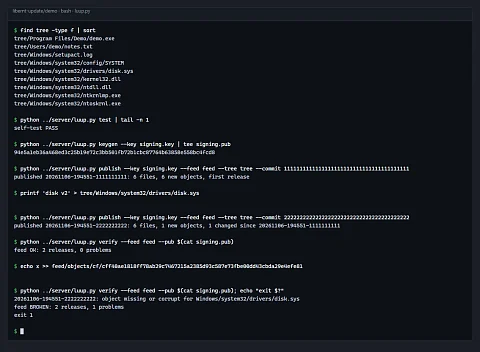
The screenshot at the top comes from a sample publisher run on 6 November 2026. From a tree of nine files it published six, leaving out a registry hive, a log and a file from a user folder. After disk.sys changed, the second release added a single new object. The verify check then passed, and once one stored file was damaged it reported a broken feed and exited with code 1.
Status and limitations
The latest client version is 0.3.1 from 5 November 2026, and the project is in development. The target is LiberNT amd64 built from the fork's nks branch at commit 5fccfb5 or newer; older installations are better reinstalled. Recovery from a boot driver crash passed in a virtual machine with UEFI (OVMF) but has not been tested on physical UEFI hardware. LiberNT builds ship unsigned EFI loaders, so firmware with Secure Boot enabled will not start them. When a driver crashes before SMSS runs, or a new loader does not start, recovery needs a second LiberNT installation and the /recover-offline switch.
CI runs the publisher tests, the client self-test and an HTTP probe on every push. A local run on 6 November 2026 passed the publisher tests and all 116 client checks; this does not replace boot and tray tests on LiberNT.
Getting started
The build machine needs Python 3.12 with PyNaCl, 7-Zip and a prepared LiberNT build tree. The key is created once:
python3 server/luup.py keygen --key /opt/luup/signing.keyThe public key goes into client/src/pubkey.h, and the client is built in Visual Studio 2022 with client\build.cmd. LiberNTUpdate.exe and luupboot.exe belong in C:\Program Files\LiberNT Update\, and the /register switch turns on automatic updates. The server/build-release.sh script with a systemd timer then fetches the nks branch every day at 04:30 UTC, builds the image and publishes it when there is a new commit or client version. Built binaries with SHA256SUMS are in the GitHub releases.
Source code
The updater lives in the nks-hub/libernt-update repository under the MIT licence; the bundled Monocypher and nlohmann/json libraries keep their own licences. The patched system is in the fork nks-hub/LiberNT under GPL 3.0, and the original project is in the LiberNT/LiberNT repository.